The Best Ai Agent Platform You Need
Introduction
Artificial Intelligence is transforming the way businesses operate. From automating customer interactions and streamlining repetitive tasks to improving productivity and enhancing decision-making, AI has become an essential part of modern business operations.
However, successful AI adoption isn’t just about implementing the right technology—it’s also about preparing the people who will use it every day.
Many businesses invest in AI solutions expecting immediate results, only to discover that employees are uncertain about how the technology works or how it fits into their daily responsibilities. Without proper planning, even the best AI solutions can struggle to deliver their full value.
This guide explains how businesses can prepare their teams for AI adoption and build a smooth transition that supports both employees and long-term business growth.
Why AI Adoption Is More Than Just a Technology Upgrade
Many businesses think adopting AI is simply about choosing the right software or implementing a new tool. In reality, successful AI adoption goes far beyond technology. It also involves preparing the people who will use it every day.
No matter how advanced an AI solution is, its success depends on how well employees understand and use it. Teams that know how AI supports their work are more likely to adopt it with confidence and make the most of its capabilities.
AI is designed to simplify repetitive tasks, improve efficiency, and support better decision-making—not replace human expertise. Employees still play a vital role in building customer relationships, solving complex problems, and making important business decisions.
When businesses prepare their teams before introducing AI, the transition becomes much smoother. Employees feel more confident, collaboration improves, and organizations are better positioned to gain long-term value from their AI investment.
The Biggest Challenges Businesses Face During AI Adoption
- Resistance to Change
Employees may worry that AI will replace their roles or significantly change the way they work. These concerns can slow adoption if they aren’t addressed through clear communication.
- Limited Understanding of AI
Many employees have heard about AI but may not fully understand its capabilities or limitations. Misconceptions can create unnecessary hesitation and reduce confidence in new systems.
- Insufficient Training
Providing new technology without proper guidance often leads to frustration. Employees need practical training that shows how AI fits into their everyday responsibilities.
- Unclear Business Goals
If employees don’t understand why AI is being implemented, they may struggle to see its value. Clearly communicating business objectives helps everyone work toward the same outcome.
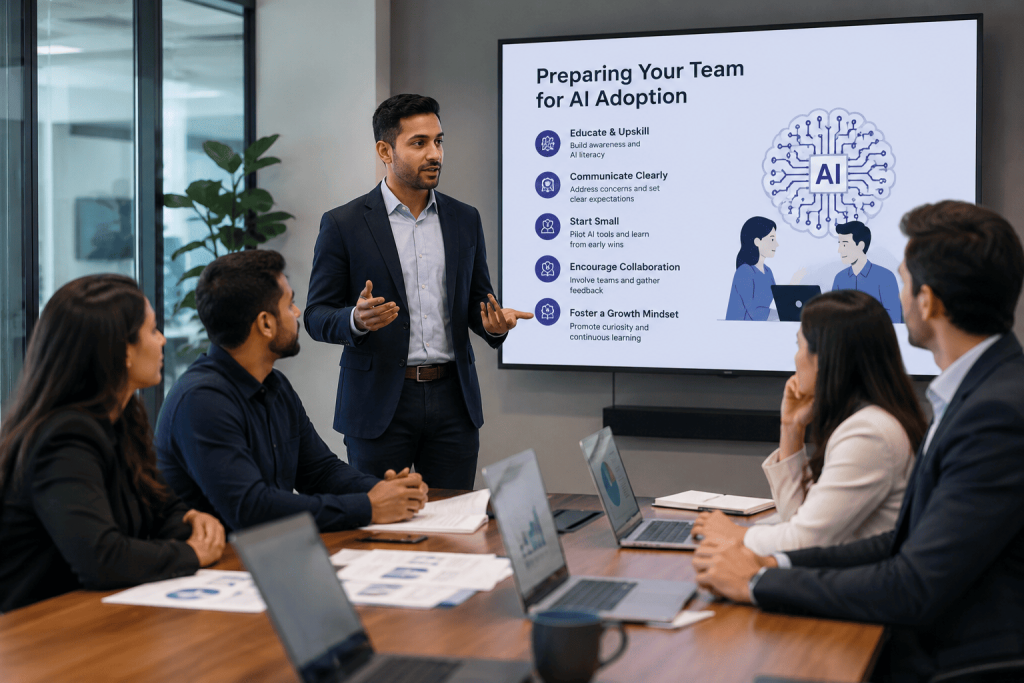
5 Steps to Prepare Your Team for AI Success
- Communicate the Purpose Behind AI
Start by explaining why your business is adopting AI.
Whether the goal is improving customer service, automating repetitive work, or increasing efficiency, employees should understand that AI is designed to support their work—not replace it.
Clear communication builds trust and reduces uncertainty.
- Start with Small, High-Impact Projects
Avoid trying to automate every process immediately.
Begin with simple use cases such as:
- Customer inquiry automation
- Frequently asked questions
- Appointment scheduling
- Lead collection
- Automated notifications
Early successes help employees become comfortable using AI while demonstrating measurable business value.
- Invest in Employee Training
Training should go beyond explaining software features.
Employees should understand how AI works, when to rely on automation, and when human involvement is still essential.
Providing ongoing learning opportunities helps teams build confidence and adapt as AI capabilities continue to evolve.
- Encourage Collaboration Between People and AI
AI performs best when it supports employees rather than replaces them.
Routine tasks like answering common questions or organizing information can be automated, allowing employees to focus on problem-solving, customer relationships, and strategic decision-making.
This partnership creates a more productive workplace while maintaining the human touch customers value.
- Measure Results and Continuously Improve
AI adoption is an ongoing journey rather than a one-time project.
Track performance, gather employee feedback, identify areas for improvement, and refine workflows over time. Continuous evaluation helps businesses maximize the long-term value of their AI investment.
Conclusion
Successful AI adoption is about more than implementing new technology—it’s about preparing people for change.
By communicating clear objectives, investing in employee training, introducing AI gradually, and encouraging collaboration between people and technology, businesses can build confidence across their teams and achieve better long-term results.
Organizations that prepare their workforce effectively are more likely to improve operational efficiency, strengthen customer experiences, and maximize the value of AI.
Ready to Start Your AI Adoption Journey?
Discover how Inforowbot helps businesses simplify customer communication through AI-powered chatbots, workflow automation, website integration, and lead management solutions designed to support long-term business growth.
Visit: https://inforowbot.ai/
FAQ
- Why is team preparation important before implementing AI?
Preparing employees helps reduce resistance to change, improves confidence, and ensures AI is adopted effectively across the organization.
- Will AI replace employees?
No. AI is designed to automate repetitive tasks while allowing employees to focus on creative thinking, decision-making, customer relationships, and higher-value responsibilities.
- How can businesses encourage employees to embrace AI?
Open communication, practical training, leadership support, and starting with simple AI projects can help employees become more comfortable with new technology.
- What business processes are commonly automated using AI?
Customer support, lead management, appointment scheduling, workflow automation, frequently asked questions, and routine administrative tasks are among the most common applications.
- How long does AI adoption usually take?
The timeline varies depending on business size and implementation goals. Starting with smaller projects and expanding gradually often leads to smoother and more successful adoption.