AI Chatbots in Healthcare: The Future of Patient Support
Healthcare is undergoing one of the biggest digital transformations in history. Patients today expect the same level of convenience from hospitals that they receive from banking, e-commerce, and travel services. They want instant answers, online appointment booking, quick access to medical information, and personalized support without spending valuable time waiting on phone calls or standing in long queues.
To meet these expectations, hospitals around the world are increasingly adopting AI chatbots for patient support. These intelligent virtual assistants are transforming the way healthcare organizations communicate with patients by providing 24/7 assistance, automating routine administrative tasks, and improving the overall patient experience.
Whether a patient needs to schedule an appointment, check doctor availability, receive medication reminders, access laboratory reports, or ask common healthcare questions, AI-powered chatbots can provide fast, accurate, and personalized responses within seconds.
Beyond improving convenience, AI chatbots also help hospitals reduce operational costs, minimize staff workload, and streamline patient communication across websites, mobile apps, WhatsApp, and other digital channels.
What is an AI Chatbot for Hospitals?
Healthcare has always relied on effective communication between patients and medical professionals. However, traditional communication methods such as phone calls, emails, and manual reception desks often lead to delays, longer waiting times, and increased administrative workload.
An AI chatbot for hospitals is an intelligent virtual assistant designed to automate these interactions while providing patients with immediate, personalized assistance.
Powered by Artificial Intelligence (AI), Natural Language Processing (NLP), and Machine Learning (ML), these chatbots understand patient questions in natural language and respond with accurate, contextual information.
Unlike traditional rule-based bots that only follow predefined scripts, AI-powered healthcare chatbots can understand intent, remember conversation context, and provide more human-like interactions.
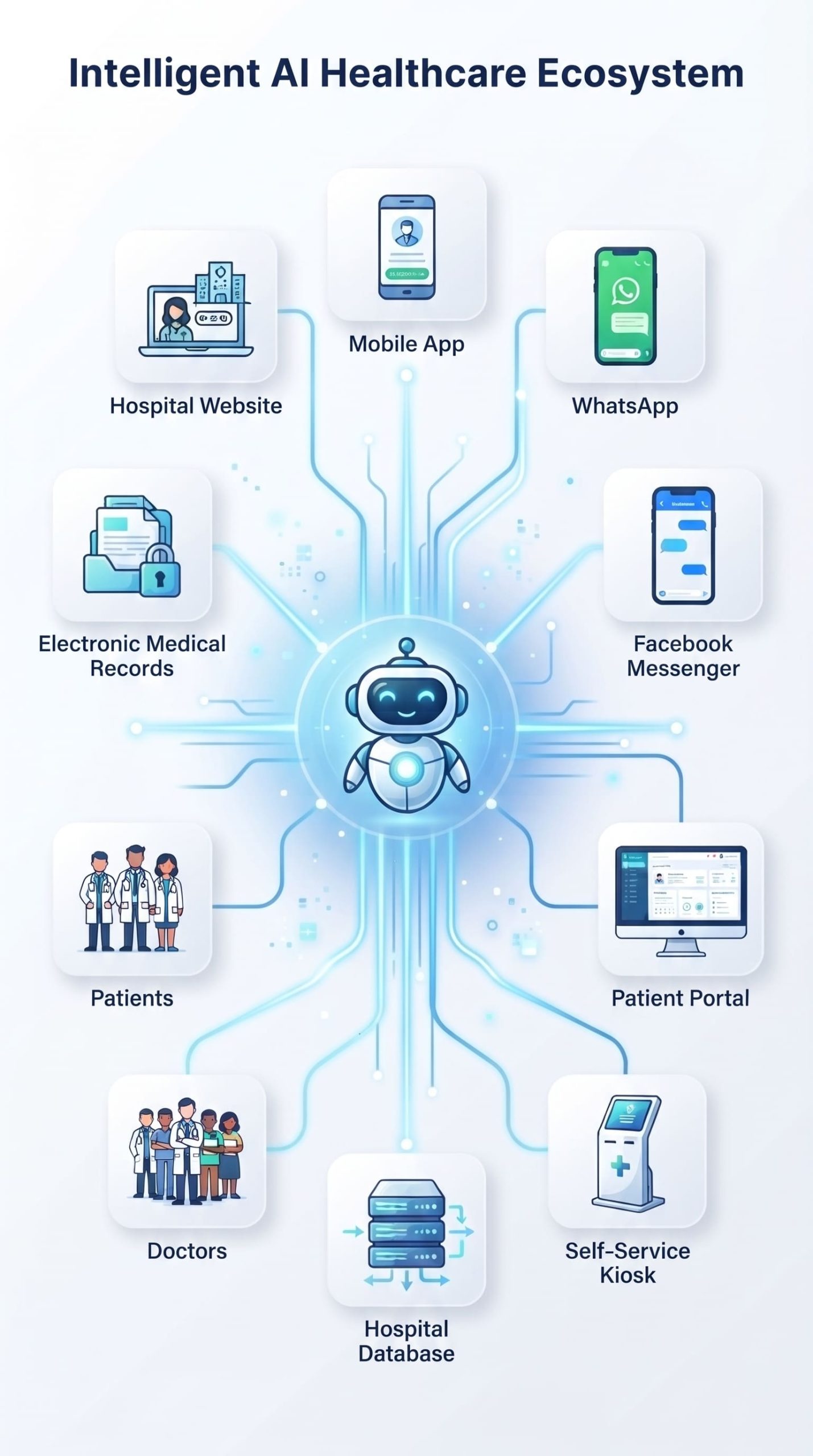
Patients can communicate with the chatbot through:
- Hospital websites
- Mobile applications
- Facebook Messenger
- Patient portals
- Self-service kiosks
- Voice assistants
These chatbots can perform a wide range of tasks, including:
- Appointment booking
- Doctor recommendations
- Symptom collection
- Appointment reminders
- Lab report notifications
- Insurance guidance
- Billing assistance
- Frequently asked questions
- Patient feedback collection
By automating routine interactions, hospitals enable healthcare professionals to spend more time on patient care rather than on repetitive administrative tasks.
Why Are Hospitals Adopting AI Chatbots?
Hospitals receive hundreds—or even thousands—of patient inquiries every day. Many of these questions are repetitive and administrative rather than clinical.
Some of the most common patient requests include:
- “How can I book an appointment?”
- “Which doctor should I consult?”
- “What are your consultation hours?”
- “Is my insurance accepted?”
- “When will my lab reports be available?”
- “How do I reschedule my appointment?”
- “What documents should I bring?”
- “Where is the cardiology department?”
Traditionally, answering these questions requires receptionists or call center staff, resulting in long wait times during peak hours and increased workload for hospital teams.
AI chatbots eliminate these bottlenecks by providing instant, automated responses 24/7. They can manage multiple patient conversations simultaneously, ensuring consistent service quality regardless of demand.
By handling routine administrative interactions, hospitals can improve efficiency while allowing doctors, nurses, and support staff to focus on delivering high-quality patient care.
Comparison: Traditional vs. AI Chatbot Support
| Feature | Traditional Hospital Support | AI Chatbot Support |
|---|---|---|
| Availability | Business hours only | 24/7 assistance |
| Appointment Booking | Phone calls or in-person | Online in seconds |
| Response Time | 5–20 minutes | Instant |
| Simultaneous Queries | Limited by staff | Unlimited conversations |
| Staff Workload | High | Significantly reduced |
| Patient Experience | Variable | Consistent and personalized |
| Operational Costs | Higher | Lower over time |
| Scalability | Limited | Easily scalable |
Top 10 Ways Hospitals Use AI Chatbots for Patient Support
Artificial Intelligence is no longer limited to answering frequently asked questions. Modern healthcare chatbots have evolved into intelligent virtual assistants capable of managing multiple patient interactions simultaneously while delivering personalized support throughout the patient journey.
From appointment scheduling to post-treatment follow-ups, AI chatbots help hospitals reduce administrative workload, improve operational efficiency, and enhance patient satisfaction.
Let’s explore the 10 most impactful ways hospitals are using AI chatbots today.
1. AI-Powered Appointment Booking
One of the most common reasons patients contact hospitals is to schedule appointments. Traditionally, this process involved phone calls, long waiting times, and manual coordination with hospital staff.
An AI chatbot simplifies this experience by allowing patients to book appointments in just a few clicks.
Patients can:
- Search for doctors by specialty
- View available appointment slots
- Select their preferred date and time
- Book instantly
- Receive confirmation via SMS, Email, or WhatsApp
- Reschedule or cancel appointments without calling the hospital
This automated process significantly reduces call center traffic while providing patients with a seamless booking experience.
Example Conversation:
Patient: I want to book an appointment.
AI Chatbot: Sure! Which department would you like to visit?
✔ Cardiology
✔ Orthopedics
✔ Pediatrics
✔ Dermatology
2. Intelligent Symptom Collection
Before patients meet a doctor, hospitals often collect preliminary health information.
AI chatbots automate this process by asking structured medical questions and organizing the responses for healthcare professionals.
Typical questions include:
- What symptoms are you experiencing?
- When did the symptoms begin?
- How severe is the pain?
- Do you have allergies?
- Are you currently taking medications?
- Do you have any existing medical conditions?
This saves valuable consultation time and helps doctors prepare before seeing the patient.
Note: AI chatbots assist with information gathering and are not a substitute for professional medical diagnosis or treatment.
3. Smart Doctor Recommendation
Many patients are unsure which specialist they should consult.
AI chatbots simplify this decision by analyzing patient symptoms and recommending the most appropriate department or doctor.
For example:
- Chest pain → Cardiologist
- Skin allergy → Dermatologist
- Joint pain → Orthopedic Specialist
- Ear pain → ENT Specialist
- Eye irritation → Ophthalmologist
Patients can then immediately proceed with appointment booking. This reduces confusion and ensures patients are directed to the right healthcare professional from the start.
4. 24/7 Patient Support
Hospitals receive hundreds of repetitive inquiries daily, such as:
- What are your visiting hours?
- Where is the emergency department?
- Which insurance providers do you accept?
- How much does a consultation cost?
- How can I download my reports?
Instead of making patients wait for business hours, AI chatbots answer these questions instantly—any time of day. This ensures patients receive immediate assistance while reducing the workload on reception and support teams.
| Patient Query | AI Chatbot Response |
|---|---|
| Hospital Timings | Instant |
| Doctor Availability | Real-Time |
| Insurance Questions | Automated |
| Billing Queries | Immediate |
| Emergency Contacts | Available 24/7 |
5. Automated Appointment Reminders
Missed appointments are one of the biggest operational challenges for hospitals.
AI chatbots automatically send reminders before scheduled consultations through WhatsApp, SMS, Email, and Mobile App Notifications.
Patients can also confirm, cancel, or reschedule directly through the chatbot. This helps reduce no-shows, improves scheduling efficiency, and ensures better utilization of hospital resources.
6. Lab Report Notifications
Waiting for medical reports can be stressful.
AI chatbots automatically notify patients when blood test results, MRI reports, CT scan reports, or X-ray reports are ready. Patients can securely download reports through the hospital portal without repeatedly contacting the hospital.
7. Medication & Follow-Up Reminders
Many patients forget to take medications or attend follow-up appointments.
AI chatbots improve treatment adherence by sending personalized reminders for medication schedules, follow-up consultations, vaccinations, health check-ups, and prescription refills. These reminders contribute to better long-term patient outcomes and encourage continuous engagement.
8. Insurance & Billing Assistance
Hospital billing and insurance procedures can often be confusing for patients.
AI chatbots simplify the process by helping patients understand insurance coverage, check eligibility, learn claim procedures, access billing information, download invoices, and view payment history. This reduces administrative delays and improves patient confidence.
9. Patient Feedback Collection
Hospitals continuously improve their services by collecting patient feedback. AI chatbots automatically send feedback forms after consultations asking questions about overall experience, staff helpfulness, doctor consultation ratings, and waiting time acceptability. The collected insights help hospitals identify improvement opportunities and enhance patient satisfaction.
10. Post-Treatment Patient Engagement
Patient care should not end after discharge.
AI chatbots continue supporting patients by checking recovery progress, sending rehabilitation exercises, sharing dietary recommendations, scheduling follow-up appointments, and providing wellness tips. This ongoing engagement improves continuity of care and strengthens patient trust.
Traditional Patient Journey vs. AI-Powered Patient Journey
| Stage | Traditional Process | AI-Powered Process |
|---|---|---|
| Appointment Booking | Phone Calls | Instant Chatbot Booking |
| Waiting Time | Long | Minimal |
| Doctor Selection | Manual | AI Recommendation |
| Symptom Collection | At Reception | Before Visit |
| Appointment Reminder | Manual Calls | Automated Notifications |
| Report Delivery | Physical Collection | Secure Digital Access |
| Medication Reminder | None | Automated |
| Patient Feedback | Paper Forms | Instant Digital Surveys |
Benefits of AI Chatbots for Hospitals and Patients
After understanding how AI chatbots support patients throughout their healthcare journey, it's equally important to understand why hospitals are rapidly adopting this technology.
AI chatbots don't just improve communication—they transform the entire hospital ecosystem by streamlining workflows, reducing operational costs, enhancing patient satisfaction, and enabling healthcare professionals to focus on what matters most: delivering quality care.
Whether it's a multi-specialty hospital, diagnostic center, or private clinic, AI chatbots create measurable improvements for both patients and healthcare providers.
Key Benefits Explained
- 24/7 Patient Support: Hospitals don't close, and neither should patient support. AI chatbots provide continuous assistance, ensuring patients receive answers to common questions at any time.
- Faster Appointment Scheduling: Patients no longer need to wait on phone calls or stand in queues. Appointments can be booked within minutes.
- Reduced Administrative Workload: Hospital staff spend significant time answering repetitive questions. AI chatbots automate FAQs, appointment booking, doctor availability, insurance queries, billing information, and report status.
- Higher Patient Satisfaction: Quick responses and personalized communication improve trust and overall patient experience.
- Better Operational Efficiency: AI chatbots handle thousands of conversations simultaneously without delays, making hospitals more efficient during peak hours.
| Benefit | Hospital | Patient |
|---|---|---|
| 24/7 Support | ✔ | ✔ |
| Faster Response | ✔ | ✔ |
| Reduced Workload | ✔ | |
| Online Appointment Booking | ✔ | ✔ |
| Better Communication | ✔ | ✔ |
| Higher Satisfaction | ✔ | ✔ |
| Lower Operational Cost | ✔ | |
| Personalized Experience | ✔ |
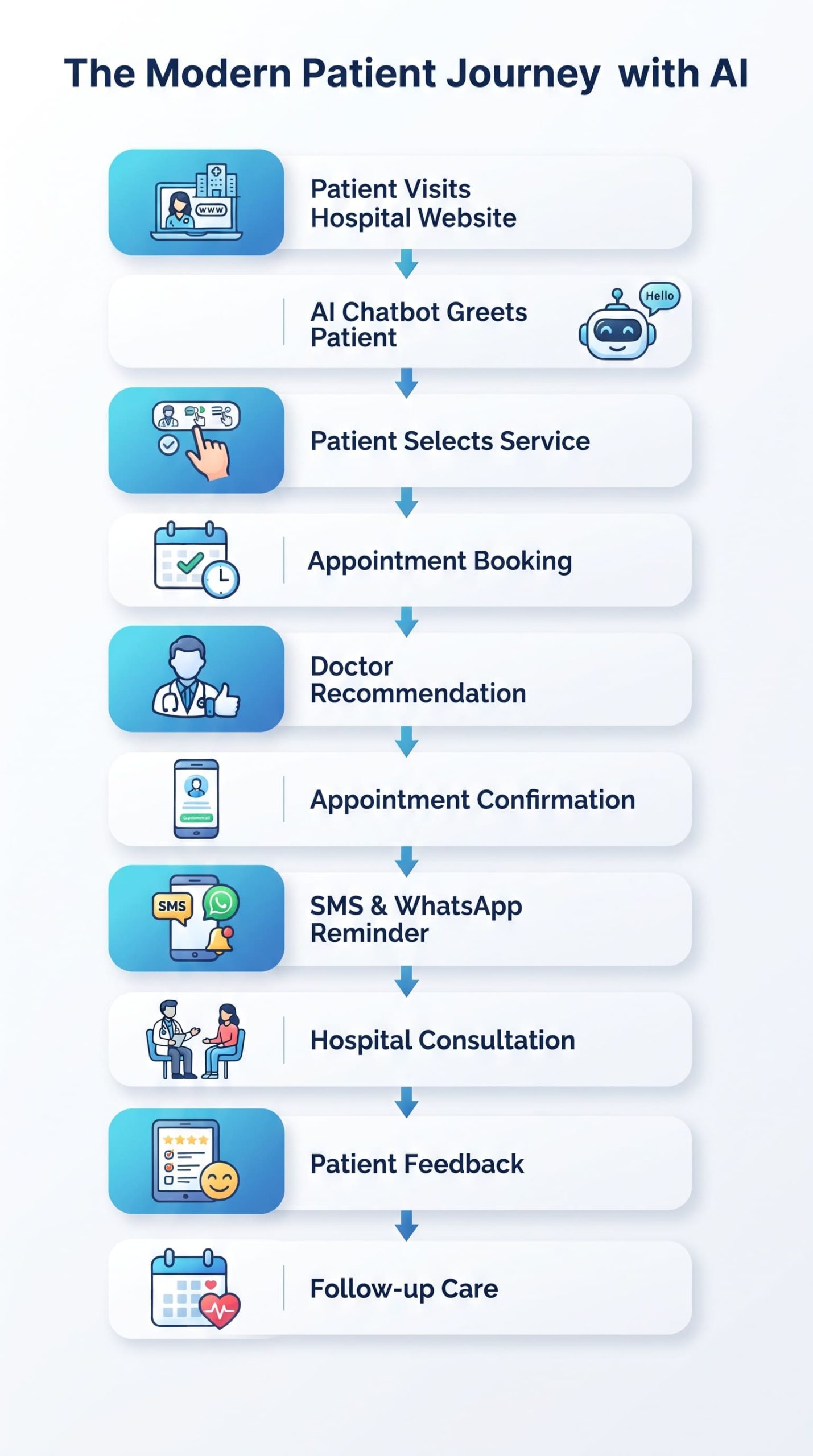
AI Chatbot Workflow in Hospitals
Understanding how an AI chatbot operates within a hospital helps demonstrate how automation enhances every stage of the patient journey.
- Patient Visits the Website: The patient accesses the hospital website, mobile app, or WhatsApp.
- AI Chatbot Greets the Patient: The chatbot instantly welcomes the patient and presents available services.
- Patient Selects a Service: Options include booking an appointment, finding a doctor, viewing reports, insurance help, or emergency assistance.
- Symptom Collection: The chatbot gathers preliminary health information.
- Doctor Recommendation: Based on symptoms, the chatbot suggests the most suitable specialist.
- Appointment Confirmation: The patient selects a preferred date and time.
- Automated Reminder: The chatbot sends reminders via SMS, Email, or WhatsApp.
- Consultation: The patient visits the hospital for treatment.
- Follow-up: The chatbot sends medication reminders, collects feedback, and schedules follow-up appointments.
Hospital Departments That Benefit from AI Chatbots
AI chatbots are not limited to one department—they support multiple specialties across the hospital.
| Department | AI Chatbot Use Case |
|---|---|
| Cardiology | Appointment Scheduling |
| Orthopedics | Follow-up Reminders |
| Pediatrics | Parent FAQs |
| Dermatology | Consultation Booking |
| Radiology | Report Notifications |
| Pharmacy | Medicine Refill Alerts |
| Billing | Payment Assistance |
| Emergency | Initial Guidance |
| Laboratory | Test Report Updates |
| Neurology | Specialist Recommendation |
Hospital KPIs Improved by AI Chatbots
| KPI | Before AI | After AI |
|---|---|---|
| Average Response Time | 10–20 Minutes | Less than 30 Seconds |
| Appointment Booking Time | 8–10 Minutes | 1–2 Minutes |
| Missed Appointments | High | Reduced |
| Staff Call Volume | High | Lower |
| Administrative Workload | High | Reduced |
| Patient Satisfaction | Moderate | High |
| Report Delivery | Manual | Instant Digital Access |
| Follow-up Success Rate | Average | Higher |
The Future of AI Chatbots in Healthcare (2026–2030)
Healthcare is moving toward a future where AI will become an integral part of every patient interaction. AI chatbots are evolving from simple virtual assistants into intelligent healthcare companions capable of supporting hospitals throughout the entire patient lifecycle.
- 1. Voice AI Assistants: Patients will increasingly interact with hospitals using voice commands instead of typing.
- 2. Predictive Healthcare: AI chatbots will analyze patient history, symptoms, and wearable device data to identify potential health risks.
- 3. Integration with Wearable Devices: Smartwatches and fitness trackers will continuously share health metrics with hospital systems.
- 4. AI-Powered Telemedicine: Chatbots will support virtual consultations by collecting patient information before appointments.
- 5. Personalized Health Coaching: Future AI assistants will provide customized wellness plans, medication reminders, and dietary advice.
Why Choose InforowBot for Hospital AI Automation?
Modern hospitals require more than a chatbot—they need an intelligent platform that integrates seamlessly with existing systems while delivering exceptional patient experiences. InforowBot is designed to help hospitals automate patient communication, reduce administrative burden, and improve operational efficiency.
Key Capabilities of InforowBot:
- 24/7 patient support & AI-powered appointment booking
- WhatsApp & website chatbot integration
- Multi-language support & doctor recommendation engine
- Symptom collection forms & automated reminders
- Lab report notifications & insurance assistance
- Patient feedback collection & CRM integration
- Analytics dashboard & secure/scalable architecture
Conclusion
Artificial Intelligence is reshaping the future of healthcare, and AI chatbots are at the forefront of this transformation. From simplifying appointment scheduling and answering patient queries to sending medication reminders and collecting feedback, AI-powered chatbots are helping hospitals deliver more efficient, accessible, and patient-focused care.
If your hospital is ready to embrace the future of healthcare automation, InforowBot provides a scalable, secure, and intelligent AI chatbot solution designed specifically to enhance patient communication and streamline hospital operations.
Frequently Asked Questions (FAQs)
1. What is an AI chatbot for hospitals?
An AI chatbot is a virtual assistant that helps patients with appointment booking, FAQs, symptom collection, reminders, and hospital-related information.
2. Can AI chatbots diagnose diseases?
No. AI chatbots can collect symptoms and provide general health information, but diagnosis and treatment must always be performed by qualified healthcare professionals.
3. Are hospital AI chatbots available 24/7?
Yes. AI chatbots can provide instant support around the clock, improving accessibility for patients.
4. Can AI chatbots integrate with WhatsApp?
Yes. Modern healthcare chatbots can integrate with WhatsApp, websites, mobile apps, and other communication channels.
5. How do AI chatbots improve hospital efficiency?
They automate repetitive administrative tasks, reduce response times, improve appointment management, and free hospital staff to focus on patient care.
6. Are AI chatbots secure for healthcare?
Yes. When implemented with encryption, authentication, and compliance with healthcare privacy regulations, AI chatbots can securely handle patient interactions.
7. Which hospital departments can benefit from AI chatbots?
Cardiology, Pediatrics, Orthopedics, Dermatology, Radiology, Pharmacy, Billing, Laboratory, Emergency, and many other departments can use AI chatbots.
8. Can AI chatbots send appointment reminders?
Yes. They can automatically send reminders through SMS, Email, WhatsApp, or mobile notifications.
9. How do AI chatbots improve patient satisfaction?
By providing instant responses, personalized communication, reduced waiting times, and seamless digital support.
10. Why should hospitals choose InforowBot?
InforowBot offers secure, scalable, AI-powered chatbot solutions with appointment automation, WhatsApp integration, multilingual support, analytics, and customizable workflows tailored for healthcare organizations.