The Best Ai Agent Platform You Need
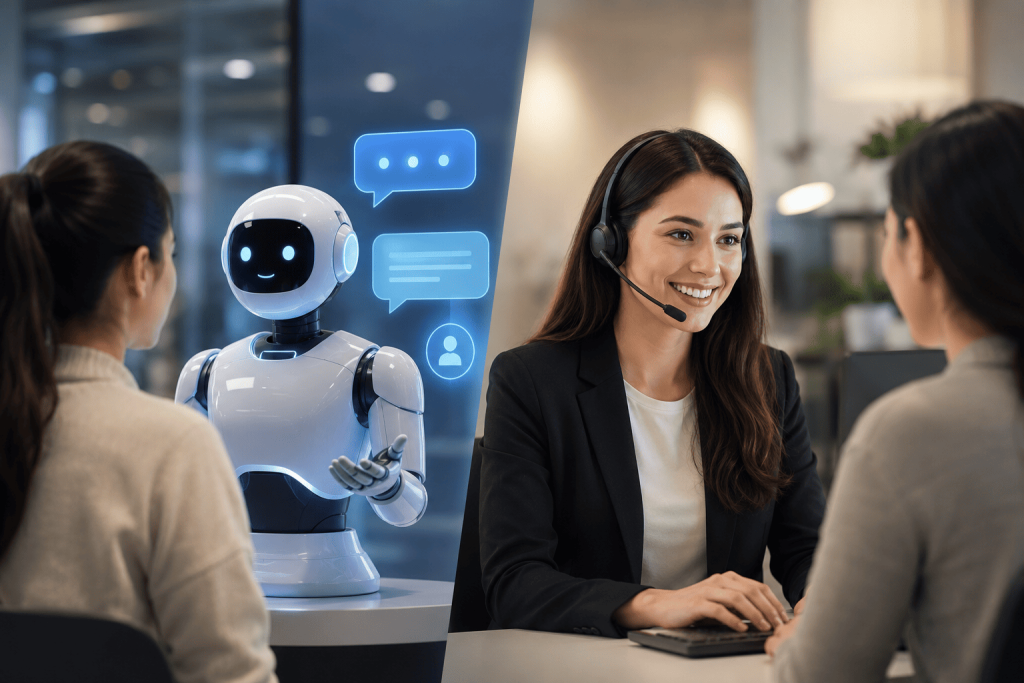
Customer expectations have changed dramatically over the past few years. Today’s customers expect instant responses, personalized interactions, and support available whenever they need it. Businesses that fail to meet these expectations often lose potential customers to competitors who can.
To address this demand, companies are increasingly investing in two popular customer communication solutions: AI chatbots and live chat support.
While both options help businesses engage with customers in real time, they operate very differently. Understanding their strengths, limitations, and ideal use cases is essential when deciding which solution is best for your organization.
So, when it comes to AI Chatbots vs Live Chat, which one delivers better results for your business in 2026?
Let’s explore.
Understanding AI Chatbots
AI chatbots are intelligent software applications powered by artificial intelligence, machine learning, and natural language processing (NLP). They can understand customer queries, provide relevant responses, automate workflows, and even perform tasks without human intervention.
Modern AI chatbots can:
- Answer frequently asked questions
- Qualify leads automatically
- Schedule appointments
- Provide product recommendations
- Retrieve information from company databases
- Handle customer support requests
- Integrate with CRM and business systems
Unlike traditional rule-based bots, advanced AI chatbots continuously learn and improve their responses based on interactions and data.
Understanding Live Chat
Live chat connects customers directly with a human support representative through a website, mobile app, or messaging platform.
This allows customers to communicate with real people who can:
- Handle complex inquiries
- Provide personalized assistance
- Resolve unique issues
- Build stronger customer relationships
Live chat remains a valuable communication channel, especially when empathy, judgment, and problem-solving are required.
However, it also depends heavily on agent availability and staffing resources.
AI Chatbots vs Live Chat: Key Differences
Feature | AI Chatbots | Live Chat |
Availability | 24/7 | Business hours or agent availability |
Response Time | Instant | Depends on queue and agent availability |
Scalability | Unlimited conversations | Limited by team size |
Operating Cost | Lower long-term cost | Higher staffing costs |
Lead Qualification | Automated | Manual |
Personalization | Data-driven personalization | Human-driven personalization |
Complex Queries | Moderate to advanced | Excellent |
Multilingual Support | Instant and scalable | Requires multilingual agents |
Consistency | Highly consistent | Varies by agent |
Learning Capability | Continuously improves | Depends on training |
Why Businesses Are Choosing AI Chatbots?
1. 24/7 Customer Availability
- Customers don’t operate on business hours.
- Whether it’s midnight, a holiday, or a weekend, customers expect quick responses.
- AI chatbots provide round-the-clock support without requiring additional staffing costs.
- This ensures businesses never miss opportunities due to delayed responses.
2. Instant Response Times
- Studies consistently show that response speed directly impacts customer satisfaction and conversion rates.
- AI chatbots respond within seconds, eliminating wait times and reducing customer frustration.
- For businesses handling high inquiry volumes, this creates a significant competitive advantage.
- Cost-Effective Customer Support
- Hiring, training, and managing customer support teams can be expensive.
- AI chatbots help businesses reduce operational costs by handling repetitive inquiries automatically. Common tasks such as:
- Order tracking
- FAQs
- Appointment booking
- Product information
- Lead qualification can be managed without human intervention.
4. Better Lead Generation and Qualification
- One of the biggest advantages of AI chatbots is their ability to identify and qualify leads automatically.
Instead of simply answering questions, AI chatbots can:
- Ask qualifying questions
- Collect contact details
- Score leads
- Route prospects to sales teams
- Schedule meetings
This turns conversations into revenue opportunities.
5. Unlimited Scalability
- A live chat agent can handle only a limited number of conversations simultaneously.
- AI chatbots can engage with thousands of users at the same time without affecting performance.
This makes them ideal for:
- E-commerce stores
- Educational institutions
- Real estate companies
- Healthcare providers
- Financial services firms
Where Live Chat Still Excels?
Despite the growth of AI, live chat remains valuable in several situations.
A] Complex Problem Resolution: Certain customer issues require critical thinking, empathy, and nuanced decision-making.
For example:
- Billing disputes
- Legal concerns
- Technical troubleshooting
- Customer complaints
Human agents are often better equipped to handle these conversations.
B] Building Emotional Connections: Customers sometimes prefer interacting with a real person, particularly when discussing sensitive or high-value purchases.
Live agents can understand emotions, adapt their communication style, and build trust more naturally.
C] High-Touch Customer Service: Luxury brands, consulting firms, and specialized service providers often benefit from personalized human interactions that create premium customer experiences.
Why Are AI Chatbots Becoming the Preferred Choice in 2026?
The biggest shift in 2026 is that AI chatbots are no longer limited to simple FAQ responses.
Today’s conversational AI solutions can:
- Understand context
- Analyze customer intent
- Access knowledge bases
- Integrate with CRMs
- Automate workflows
- Escalate conversations to human agents when needed
This means businesses can combine automation and human support seamlessly.
Instead of replacing human agents, AI chatbots are becoming intelligent assistants that handle routine interactions while allowing teams to focus on higher-value tasks.
The Best Solution: AI Chatbots + Human Support
The debate isn’t necessarily about choosing one over the other.
The most successful businesses use a hybrid customer engagement model.
A] AI Chatbots Handle:
- Frequently asked questions
- Lead qualification
- Appointment booking
- Order tracking
- Information retrieval
- Initial customer interactions
B] Human Agents Handle:
- Complex inquiries
- Escalations
- Sensitive issues
- Relationship building
- Strategic conversations
This approach provides:
- Faster response times
- Lower operational costs
- Improved customer satisfaction
- Better lead management
- Increased team productivity
How AI Chatbots Drive Business Growth?
Businesses implementing AI-powered chatbots often experience:
1. Higher Conversion Rates: Instant responses reduce customer drop-offs and improve conversion opportunities.
2. Improved Customer Satisfaction: Customers receive immediate assistance whenever they need it.
3. Increased Lead Capture: AI chatbots engage website visitors proactively and collect valuable customer information.
4. Reduced Workload: Support teams spend less time answering repetitive questions.
5. Better Data Insights: AI systems provide analytics on customer behavior, common questions, and purchasing intent.
Why Businesses Are Adopting AI Chatbots Faster Than Ever
The rise of AI-powered customer engagement is driven by several factors:
- Increasing customer expectations
- Growing demand for instant support
- Rising labor costs
- Need for operational efficiency
- Advances in conversational AI technology
Organizations that embrace AI-driven communication gain a significant advantage in customer experience and business scalability.
How InforowBot Helps Businesses Automate Customer Conversations?
InforowBot.ai empowers businesses with intelligent AI chatbot solutions designed to improve customer engagement, automate support, and generate qualified leads.
With InforowBot, businesses can:
- Automate customer interactions 24/7
- Qualify leads automatically
- Integrate with existing business systems
- Access company knowledge instantly
- Improve employee productivity
- Deliver personalized customer experiences
Whether you’re a startup, SME, or enterprise organization, InforowBot helps transform conversations into business opportunities.
Conclusion
When comparing AI Chatbots vs Live Chat, the answer depends on your business goals, customer expectations, and operational requirements.
Live chat remains valuable for complex and emotionally sensitive interactions. However, AI chatbots offer unmatched scalability, availability, efficiency, and automation capabilities.
In 2026, businesses seeking growth, efficiency, and superior customer experiences are increasingly adopting AI-powered chatbot solutions as a core part of their customer engagement strategy.
The future isn’t AI chatbots or live chat—it’s leveraging both intelligently to create seamless, customer-centric experiences.
Frequently Asked Questions (FAQs)
1. What is the main difference between AI chatbots and live chat?
AI chatbots use artificial intelligence to automate conversations and respond instantly, while live chat connects customers with human agents for real-time support.
2. Are AI chatbots better than live chat?
AI chatbots are better for handling repetitive tasks, lead qualification, and 24/7 support. Live chat is better for complex issues requiring human judgment and empathy.
3. Can AI chatbots replace customer support teams?
AI chatbots can automate many routine tasks, but human agents are still essential for handling complex inquiries, escalations, and relationship-building activities.
4. Do AI chatbots improve lead generation?
Yes. AI chatbots can engage visitors, collect information, qualify leads, schedule appointments, and direct prospects to the sales team automatically.
5. Are AI chatbots suitable for small businesses?
Absolutely. AI chatbots help small businesses provide professional customer support, automate workflows, and capture leads without needing large support teams.
6. Can AI chatbots work alongside live chat agents?
Yes. Many businesses use a hybrid approach where AI chatbots handle routine interactions and transfer complex cases to human agents when necessary.
7. How do AI chatbots reduce operational costs?
By automating repetitive customer interactions, reducing support workload, and minimizing staffing requirements, AI chatbots help businesses lower operational expenses.
8. Why should businesses choose InforowBot.ai?
InforowBot.ai provides intelligent, scalable AI chatbot solutions that automate customer support, improve lead generation, enhance employee productivity, and deliver 24/7 customer engagement.
9. How long does it take to implement an AI chatbot for a business?
The implementation timeline depends on the complexity of the chatbot and the required integrations. Basic AI chatbots can often be deployed within a few days, while advanced solutions integrated with CRM, ERP, knowledge bases, and business workflows may take a few weeks. Platforms like InforowBot.ai are designed for quick deployment and seamless integration.
10. Which industries benefit the most from AI chatbots?
AI chatbots are valuable across multiple industries, including real estate, healthcare, education, e-commerce, banking, insurance, travel, hospitality, and customer service. Any business that handles customer inquiries, lead generation, appointment scheduling, or support requests can benefit from AI-powered chatbot automat
Contact Inforowbot for more details